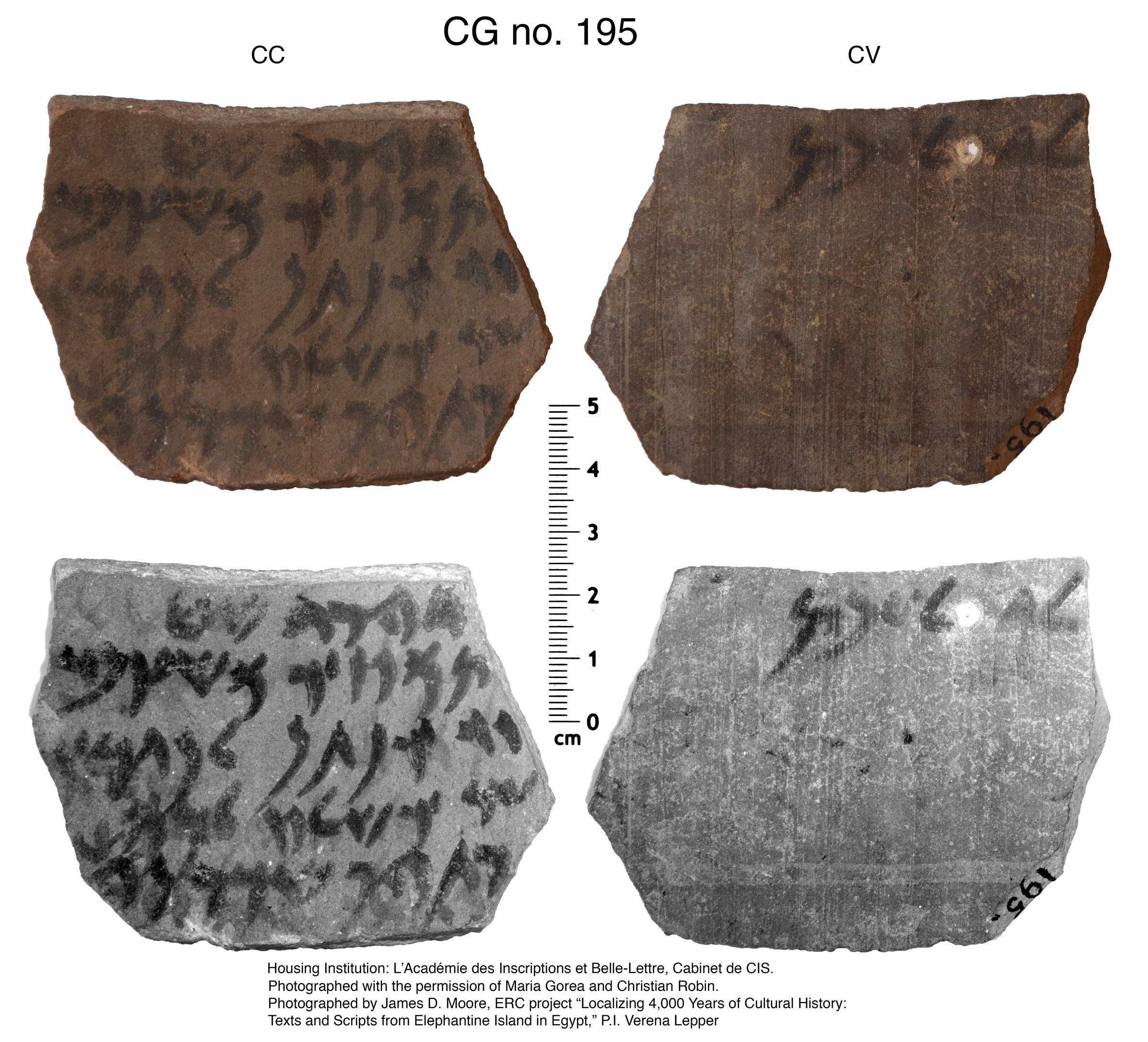
Ostr. Paris, AIBL Clermont-Ganneau no. 195
TEI-XML-File: https://p612399.webspaceconfig.de/xml/elephantine_erc_db_313079.tei.xml
Metadata
Collection
| Inventory Number |
Ostr. Paris, AIBL Clermont-Ganneau no. 195 |
| Publication Number |
Mémoires 35 no. 195 |
| Current Location |
Paris, Académie des Inscriptions et Belles-Lettres |
| Publication Permission Status |
no permission for publication necessary |
| Publication Status |
published |
Origin / Provenance
| Ancient Provenance Site |
Elephantine (Ꜣbw; Yb; YbꜢ; YbꜤ; Ἐλεφαντίνη, יב , ⲉⲓⲏⲃ) [Trismegistos]
Certainty: |
| Ancient Provenance District |
Upper Egypt, 1st nome (Ombites) [Trismegistos] |
| Type of Discovery |
archaeological excavation
Certainty: |
Date of Discovery
Term. Ante / Post Quem Non |
between 16 3 1908 and |
| Finder (= First Purchaser) |
Clermont-Ganneau, Charles
Certainty: |
| Location of Find / Purchase in Egypt |
Elephantine |
| District of Find / Purchase in Egypt |
Upper Egypt, 1st nome (Ombites) [Trismegistos] |
Object
| Object Type |
ostracon |
| Range of Preservation |
complete |
| Mounting |
(unknown) |
| Comments on Object |
Palimpsest and erasure.
Mesurements and remarks from publication.
Lozachmeur: cv: 5YR5/3 ; cc: 5YR5/3 darkened. |
Text Basic Information
| Localization of Text on Object |
concave/convex (inside/outside) |
| Text-Localization, Addendum |
cc perpendicular. |
| Script, Primary |
Aramaic, Imperial |
| Language, Primary |
Aramaic, Imperial |
| Comments on Handwriting |
Lozachmeur hand Ib. |
| |
recto |
verso |
| Quantity of Lines |
x+1 |
x+5+y |
| Height of Line / Letter |
|
|
Text Content
| Modern Title |
Missive. Fragmentary. Re Flour |
| Text Types |
- documentary
- documentary | letter
|
| Summary of Content |
Context is unclear. |
| Location of Composition |
Elephantine / Syene (Certainty: high) |
| Multilingualism |
Monolingual |
| Religion |
unknown |
| Religion, further |
unknown |
Text
| Transcription |
Translation |
Pictures |
|
| | cc. 01. [...]יהוי שט [...]
|
| | cc. 02. [...]קמחא משצבר[...]
|
| | cc. 03. [...]זי אנתנ לנג{ר|ד}א[...]
|
| | cc. 04. [...]עד אשלח לכמ[...]
|
| | cc. 05. [...◦]ותהושרונה[...]
|
| | cv. 01. לי לעבק
|
| | cc pal. 01. --
|
| | cc pal. 02. --
|
| | cc pal. 03. --
|
| | cc pal. 04. --
|
1 | | יהוי שטHL = “battu” < √שטי. But compare √שטט
used to describe the feature of a tunic in EM 43477 ln. 8.
|
2 | | קמחא משצברHL translates “la farine, ayant été
collecté(e)”, deriving the word from √צבר. Presumably she reads this as a
šaˁfel participle. The √צבר is not attested in the C-stem in NWS, and the
Š-stem is a sign of possible borrowing from Akk. To translate with a passive
meaning seems unlikely. Instead read from Akk. Š-stem < ṣabāru “to spin”
and in the context of flour presumably a miller, who spins the round
millstones.
|
3 | | זי אנתנ
לנגרא
לנגדא
|
4 | | עד אשלח לכמ |
5 | | ותהושרונהי
1 HL = “battu” < √שטי. But compare √שטט
used to describe the feature of a tunic in EM 43477 ln. 8.
2 HL translates “la farine, ayant été
collecté(e)”, deriving the word from √צבר. Presumably she reads this as a
šaˁfel participle. The √צבר is not attested in the C-stem in NWS, and the
Š-stem is a sign of possible borrowing from Akk. To translate with a passive
meaning seems unlikely. Instead read from Akk. Š-stem < ṣabāru “to spin”
and in the context of flour presumably a miller, who spins the round
millstones.
|
1 | | ...◦ ...◦
◦ט
◦ע
|
2 | | ◦כא ◦... |
3 | | ... |
4 | | הלו ◦מ◦◦◦
|
1 | | [... ]it/he shall be ŠṬ |
2 | | [... (as for)]the flour, a miller/spinner |
3 | | [... ]which I shall give to the official/carpenter |
4 | | [... ]until I send (word) to you (m.p.) |
5 | | [... ]and you shall send it
|
1 | | [...]...◦ ...◦ ◦{Ṭ|ˁ} |
2 | | [...]◦⸢K⸣ ◦... |
3 | | [...]... |
4 | | [... ]Indeed, ◦M◦◦◦
|
![]() |
| Paris_AIBL_CIS_CG-195_ |
|
|
| CC-BY-NC-SA |
![]() |
|
| |
|
|
| Places (read out from edition) |
|
|
Dates
| RulerID |
Regnal Year |
MonthID |
Day Date of the Text |
Gregorian Date |
dating_comment |
|
|
|
|
-525 BCE -399 BCE |
; |
Pictures
![]() |
| Paris_AIBL_CIS_CG-195_ |
|
|
| CC-BY-NC-SA |
![]() |
Literature
| DatasetID |
313079 |
| last Change |
29.07.2022 |
| Author |
James D. Moore, Emil Joubert (metadata) |
| Dataset License |
Creative Commons: Attribution-NonCommercial-ShareAlike 4.0 International
(CC BY-NC-SA) |
| Data set citation |
Data set 313079 (= Ostr. Paris, AIBL Clermont-Ganneau no. 195), ERC-Project ELEPHANTINE: James D. Moore, Emil Joubert (metadata) . |
|